Renowned as a conductor of “uncommon emotional intensity” (Marie-Celine) and a “force at the podium” (Eugene Scene), American conductor Mélisse Brunet is a native of Paris, France with Spanish and Italian roots. She is quickly gaining attention on both sides of the Atlantic as “a skilled and polished conductor with an excellent pedigree… Brunet led the orchestra with panache and clarity, giving inspiring and assured renditions of each work.” (Cleveland Classical). In July 2022, she became the fifth Music Director of the Lexington Philharmonic, and the first woman to hold the position. She is also in her seventh season as the Music Director of the Northeastern Pennsylvania Philharmonic, and has recently accepted contract extensions with both orchestras.
Brunet is one of the five conductors featured in the documentary “Maestra” by the Director Maggie Contreras, winner of 2nd place and the 2023 Tribeca Film Festival Audience Award for Best Documentary. The film’s exploration of Brunet’s daring journey at the international La Maestra competition has received rave reviews in the press, including two articles in the New York Times, the Los Angeles Times, and the Hollywood Reporter. A passionate speaker on issues ranging from music scholarship to human rights, Brunet has recently appeared as a speaker at venues ranging from the Curtis Institute of Music to the French Embassy. In 2026, Brunet was recognized by GO Magazine as one of their “100 Women We Love,” a curated list celebrating queer women with outstanding achievements in their respective fields.
Brunet is a finalist Music Director candidate with the Canton Symphony (Canton, OH), and the Plano Symphony (Plano, TX) in their 2026-27 searches. Other recent and upcoming engagements include her Carnegie Hall debut in a program of new works leading the American Composers Orchestra, as well as performances with the Louisville Orchestra, Phoenix Symphony, Sacramento Philharmonic, Louisiana Philharmonic, Nashville Symphony, Indiana University’s Jacobs School of Music, the Eugene Symphony, and the Orchestre National Avignon-Provence (France).
As a dynamic advocate of contemporary music, Brunet has collaborated with composers such as Shawn Okpebholo (appointing him as the Lexington Philharmonic’s first-ever Black composer-in-residence), Brittany J Green, Mary D. Watkins, T.J. Cole, Steven Stucky, Michael Daugherty, Shulamit Ran, James Barry, Loren Loiacono, and Jennifer Higdon, among others. She also creates her own acclaimed orchestral arrangements, including Dolly Parton’s “Color Me America” and Whitney Houston’s iconic 1991 Superbowl National Anthem for solo soprano and orchestra.
As an opera and musical theater conductor, Brunet has conducted Dead Man Walking by Jake Heggie and Puccini’s Gianni Schicchi at the Power Center in Ann Arbor; four staged performances of Mozart’s Die Zauberflöte; and Bernstein’s Trouble in Tahiti, Menotti’s The Old Maid and the Thief, Sondheim’s Sweeney Todd, and Strauss II’s Die Fledermaus, and two staged performances of Verdi’s La Traviata.
Brunet is a respected educator in both France and the USA. Most recently, she served as the first woman Director of Orchestral Studies at the University of Iowa-School of Music, where she conducted symphonic concerts, operas, and musical theater.
Brunet began her studies on the cello, and learned to play the trumpet, French horn, and piano. She holds six diplomas from the Paris Conservatory, a bachelor’s in music from the Université la Sorbonne, a Professional Studies diploma from the Cleveland Institute of Music, and a Doctorate in conducting from the University of Michigan. As a true citizen of the world and intrepid conversationalist, she speaks English, French, Italian, Chinese, as well as some rusty Spanish, Hebrew, and German.
Learn more at melissebrunet.com.


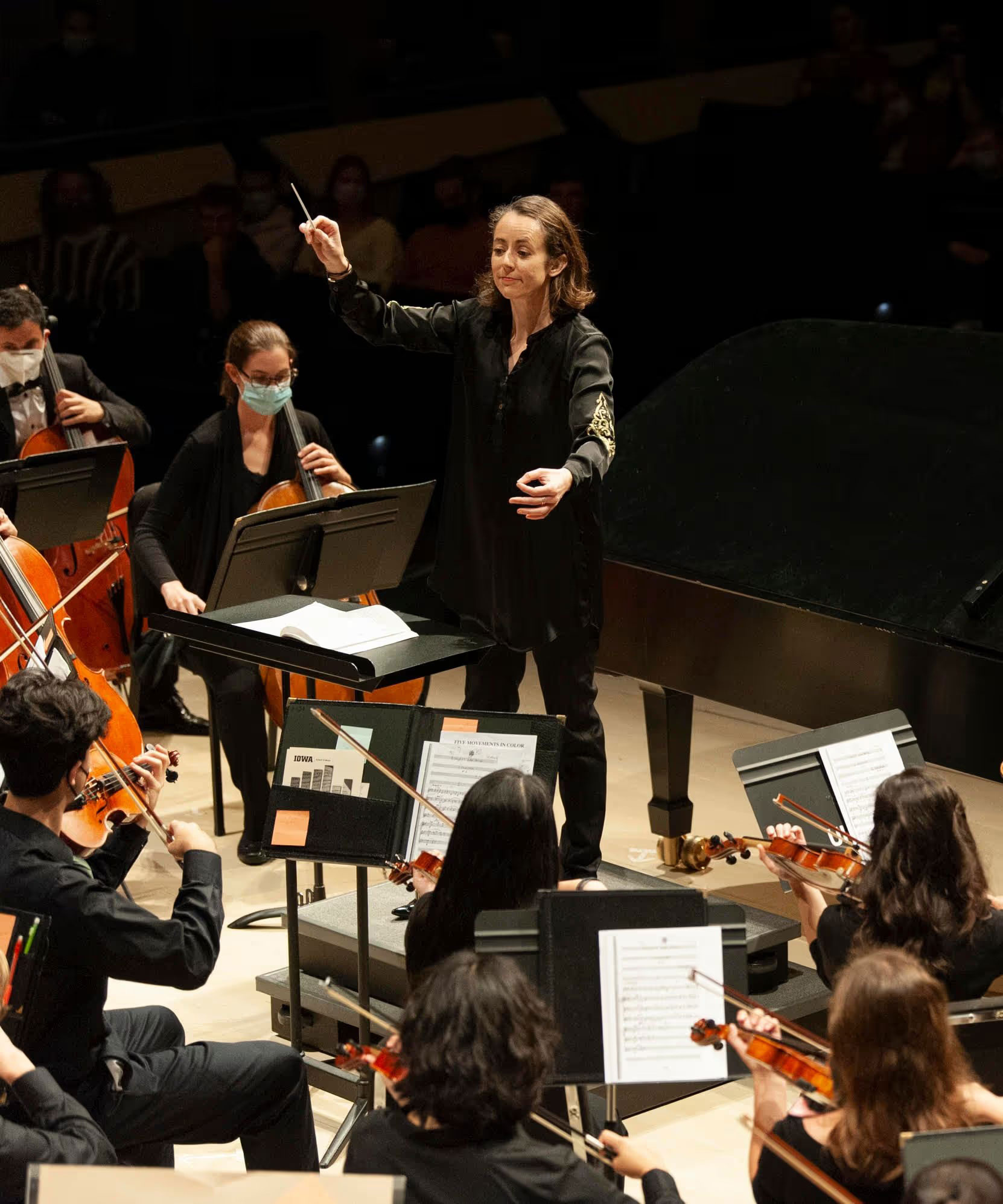


It must be mentioned that Mélisse Brunet was able to share with everyone all her natural delicacy thanks to her extremely precise conducting and deep musical sensibility. This evening of music was of an uncommon emotional intensity. The symphonic repertoire conducted with such mastery by Mélisse Brunet literally hypnotized the audience.



